
The short answer: start with the setup, not the animal's size
For many apartments, rats, gerbils, or a Syrian hamster are sensible small-pet options to investigate. That is not because they can live in a tiny cage. It is because a properly sized, enriched enclosure may fit into some homes more easily than the large floor areas needed by guinea pigs or rabbits.
Your routine matters just as much as your floor plan. Rats need other rats, daily interaction, and safe time outside their cage. Gerbils need a companion and deep bedding for tunnelling. A Syrian hamster should live alone and will usually become active when you are winding down. Guinea pigs need company and generous floor space. Rabbits are not compact cage pets. Chinchillas need a large, cool, carefully equipped home and may be active while you are trying to sleep.
There is no winner for every apartment. The best choice is the one whose complete setup, active hours, social needs, cleaning, costs, and veterinary care fit your real home.
Measure the home before you fall for the face
A small body can be misleading. A small animal is not an easy starter pet for a child. If that is the plan, compare family options in best pets for kids and families. The animal may also need companions, hides, separate resources, deep bedding, a large wheel, tunnels, hay storage, an exercise area, or safe time outside the enclosure. Measure all of that, not the box pictured on a shop shelf.
Mark the proposed footprint on the floor with tape. Open nearby doors and cupboards. Sit where you usually relax and imagine the sound of digging, chewing, a wheel, or a water bottle at midnight. Check direct sun, radiators, draughts, cables, other pets, and the route you will use when cleaning.
If you rent, confirm permission for the species and enclosure before bringing anyone home. The renting with a pet guide covers written permission, building rules, damage, neighbours, and the moving plan.
A practical small-pet comparison
These are starting points, not guarantees about an individual animal. Exact housing guidance can vary by country and change as welfare evidence improves. Check current advice from a reputable rescue, welfare organisation, and a vet who knows the species before buying equipment.
Budgies, leopard geckos, fish, and other compact species may also live indoors, but they are not interchangeable with small mammals. Their flight, lighting, heat, humidity, water, diet, and veterinary requirements deserve their own comparison rather than a token row in this one. Compare common first reptiles in best pet reptiles for beginners.
| Option | Social and housing reality | Apartment fit to think about |
|---|---|---|
| Rats | Keep a compatible pair or group in a large, tall, enriched cage, with daily attention and supervised exercise outside it | Engaging and trainable, but not a hands-off pet; expect climbing, chewing, night activity, scent marking, and regular cleaning |
| Syrian hamster | House alone in a large, secure enclosure with deep bedding, a suitable solid wheel, hides, and room to forage | One enclosure can be easier to place, but most interaction and wheel noise happen in the evening or at night |
| Gerbils | Keep a compatible same-sex pair or stable group in a secure tank-style home with deep bedding for tunnels | Fascinating to watch and often active in bursts, but digging, chewing, and night activity make the bedroom a poor location for light sleepers |
| Guinea pigs | Keep with guinea-pig companions in a broad floor-level home with hides, hay, and a large exercise area | Friendly and expressive, but the floor footprint, hay, daily spot-cleaning, and vocal greetings surprise people expecting a compact cage |
| Rabbits | Usually need a compatible rabbit companion and a large, secure living and exercise area, not a hutch in the corner | They can suit the right indoor home, but need serious floor space, rabbit-proofing, litter and hay management, and protection for cables and furniture |
| Chinchillas | Keep with suitable chinchilla company in a very large, tall, enriched home with safe exercise space and dust baths | A specialist choice: they are active around dawn, evening, and night, need cool conditions, and can live for many years |
Rats suit people who want a relationship, not a display pet
Rats can be wonderful apartment companions for someone who wants an intelligent, social animal and has time to be involved every day. They need rat company even when they are close to their humans. A pair or small compatible group needs a large cage with solid flooring, climbing routes, hammocks, shelters, nesting material, and things to investigate.
The cage is only home base. Blue Cross advises at least an hour of exercise outside it each day, and the RSPCA recommends supervised free-ranging in a rat-safe room or large pen. That means checking gaps, wires, furniture, plants, and anything you would rather not have chewed.
They are mainly active at night, so a wheel, climbing cage mate, or enthusiastic cardboard renovation can be audible after dark. If the only available space is beside your pillow, be honest about whether that will work for both you and the rats.
A Syrian hamster needs room and a compatible clock
A Syrian hamster can suit a household that wants one animal rather than a pair or group. Syrian hamsters are solitary and should not share an enclosure. Living alone does not make their housing needs small: they still need a generous secure home, deep bedding for burrowing, suitable nesting material, hides, foraging opportunities, and a correctly sized solid wheel.
They are nocturnal. A hamster who sleeps through your free afternoon and starts rearranging the enclosure at 11pm is not being difficult. That is the routine you chose. They may be a poor match for a young child who expects daytime handling, or for a studio where every wheel turn reaches the bed.
Gerbils turn enclosure space into an underground world
Gerbils can be a good choice if you enjoy watching animals build, tunnel, chew, and pop up to inspect what is happening. They are social and should not be kept alone. A bonded same-sex pair or stable group needs a secure gerbilarium or tank with a ventilated lid and a deep layer of suitable material that can hold tunnels.
That setup has a different shape from a rat cage. It takes real shelf or floor space, becomes heavy when filled, and needs room for a sand bath, nest, water, and chew-safe enrichment. Gerbils can be active during the day, evening, and night. Blue Cross specifically notes that their tank may disturb you in a bedroom.
Do not casually add a new adult gerbil to an established pair or group. Introductions and group changes can be difficult, so ask a knowledgeable rescue for help rather than improvising.
Guinea pigs take more floor than their size suggests
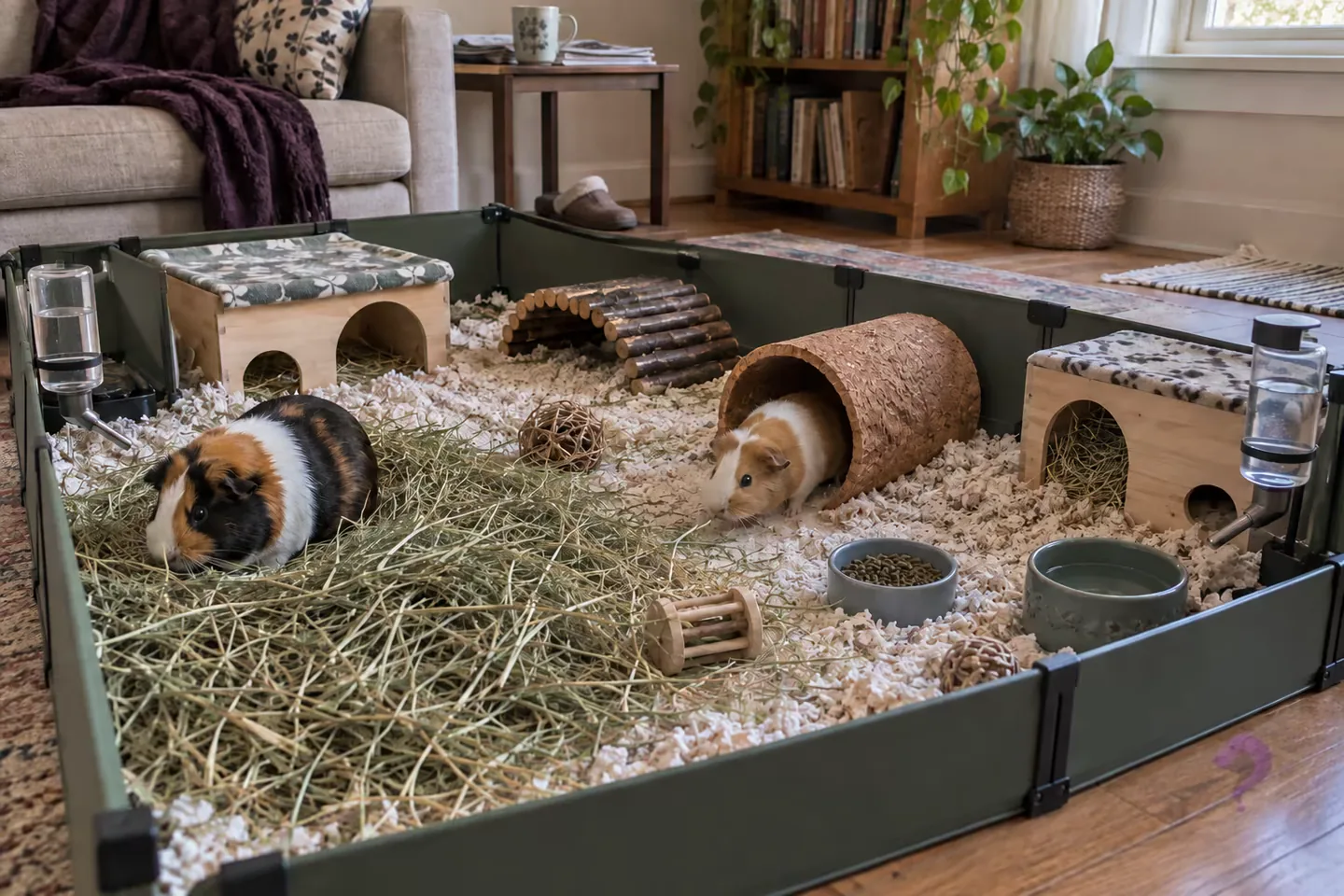
Guinea pigs are social animals and should not live alone. Their home needs a large solid floor, exercise room, shelters, hay, and enough resources for the group. They are not climbers who can make up for a narrow footprint with tall shelves, so their enclosure can claim a noticeable part of a living room.
They can be cheerful, engaging housemates, especially for someone whose routine includes fresh food, hay, daily spot-cleaning, regular deeper cleaning, and gentle observation. They may call loudly when they hear the fridge or expect food. That can be charming in your own kitchen and less charming through a thin shared wall at 6am.
Hay and bedding also travel. If a permanently tidy, dust-free corner is essential, look at the real daily setup before deciding that guinea pigs are an easy apartment pet.
Rabbits are small animals with room-sized needs
Rabbits are often suggested for apartments because they do not bark and can learn to use a litter area. The missing part of that advice is space. PDSA recommends that a pair have constant access to a living area at least 3m by 2m by 1m high. That is closer to a small room than a cage.
They also need rabbit company, hiding places, hay, enrichment, safe exercise, and protection from cables, toxic plants, furniture, and escape routes. Litter habits help, but they do not remove hay, shedding, chewing, or cleaning.
Rabbits can thrive indoors when the household genuinely plans around them. They are not the answer when the plan is to keep a quiet animal in a small hutch because the apartment cannot accommodate a cat or dog.
Chinchillas need cool air and a long view of the future
Chinchillas may look compact, but their needs are specialist. PDSA recommends keeping them in pairs and providing a very large indoor enclosure, or ideally their own safe room, with levels, hides, chewing material, exercise space, and regular dust baths.
Temperature can rule a home in or out. Their dense coat makes overheating dangerous, and PDSA advises a cool environment away from direct sun and draughts. They are also active in the early morning, evening, and night, and can live for up to 15 years.
Before choosing chinchillas, price the full enclosure, temperature control, dust and cleaning, a compatible pair, holiday care, and access to a vet confident with the species. A hot top-floor flat with no reliable cooling is not made suitable by buying a fan after the animals arrive.
Quiet is more complicated than “does not bark”
Small mammals make a different kind of noise. Wheels hum. Gerbils excavate against glass. Rats climb bars and remodel cardboard. Guinea pigs whistle for breakfast. Rabbits can thump, dig, and chew. Chinchillas may jump between levels while the household sleeps.
Put the enclosure where normal activity will not repeatedly wake people or disturb the animals. A living area may be better than a bedroom, but avoid speakers, constant foot traffic, kitchen fumes, direct heat, and sudden noise. Ask neighbours what sound carries through the building before a complaint forces a rushed move.
No responsible source can promise a silent animal. If silence is essential, an animal whose routine includes night movement may not be the right commitment.
Cleaning and smell begin with the setup
Healthy small mammals are not automatically smelly. Odour usually becomes a problem when housing is too small, ventilation is poor, bedding is unsuitable, wet areas are left too long, or the cleaning routine does not match the number and species of animals.
Plan for daily checks and spot-cleaning, regular fuller cleans, hay and bedding storage, rubbish, laundry, and the time needed to rebuild enrichment. Over-cleaning can also be stressful when it removes every familiar scent, so follow current species-specific guidance rather than stripping the enclosure whenever you notice a normal animal smell.
Air fresheners are not a care plan and may be inappropriate around sensitive animals. If persistent odour appears despite good housing and hygiene, speak to a species-experienced vet instead of masking it.
Vet access and holiday care can settle the decision
Call local practices before adoption and ask who routinely treats the exact species, how out-of-hours care works, and how far you would need to travel. “We see small pets” is worth clarifying. A clinic comfortable with rabbits may not have the same experience with rats, gerbils, hamsters, or chinchillas.
Ask a prospective carer to describe the feeding, cleaning, handling, medication, temperature, and escape-prevention routine back to you. Moving a large enclosure for every trip may be unrealistic, and a general dog sitter may not be equipped to recognise illness in a prey species.
Use the pet-cost guide to budget for companions, replacement equipment, bedding, hay, cooling, boarding, transport, and emergency care, not just food.
When waiting is the kinder choice
Wait when the only possible enclosure is smaller than current welfare guidance, the animals' active hours will keep the household awake, or the budget works only if nobody gets sick. Also wait if you cannot provide required same-species company, a safe exercise area, temperature control, written housing permission, or suitable veterinary care.
The one pet or two guide explains why social species need the right companion while a Syrian hamster needs a home of its own. The general apartment guide helps with the broader questions of building access, neighbours, daily routine, and long-term housing.
Waiting is not failing to rescue or missing your chance. It is choosing not to make an animal live inside the space left over after everything else.
Small-pet apartment checklist
Run through the practical setup before choosing a species or reserving an animal.
This guide is a starting point, not a substitute for current species-specific advice. Housing standards, social needs, health, temperature, and safe handling vary by species and individual. Before committing, check current guidance and speak with a reputable rescue and a vet experienced with that species. Seek veterinary advice promptly if an animal is unwell or behaves differently.
Common questions
What is the best small pet for an apartment?
There is no universal winner. Rats, gerbils, or a Syrian hamster may fit some apartments when their full enclosure, active hours, care, and veterinary needs work for the household. Guinea pigs, rabbits, and chinchillas generally need more space or specialist conditions than their body size suggests.
What is the quietest small pet for an apartment?
No small mammal is silent. Hamsters may run on wheels at night, gerbils dig and chew, rats climb and play, guinea pigs vocalise, rabbits thump, and chinchillas jump between levels. Match the enclosure location and the species' active hours to your sleep and building.
Can a hamster live happily alone?
A Syrian hamster should live alone. Solitary housing does not mean a small or empty enclosure. The hamster still needs deep bedding, a suitable wheel, hides, foraging, enrichment, and gentle care on its own schedule.
Are guinea pigs good pets for small apartments?
They can be, but only when the apartment has room for a broad floor-level home and exercise area for guinea-pig companions. Plan for hay, daily spot-cleaning, regular deeper cleaning, and vocal sounds as well as the enclosure itself.
Can rabbits live in an apartment?
Yes, in a properly planned indoor home with rabbit company, substantial permanent floor space, safe exercise, enrichment, litter and hay management, and thorough rabbit-proofing. A small hutch or cage in the corner is not enough.
Which small pet is lowest maintenance?
None is genuinely low maintenance when housed well. The work simply changes: social interaction, deep bedding, hay, exercise, cleaning, temperature control, or specialist vet access. Choose the routine you can sustain rather than the animal marketed as easiest.
Sources and further reading
Welfare and care statements on this page are informed by publicly available guidance from recognised animal-welfare organisations. Always check current advice for your location.
- Choosing the right small pet - Blue Cross
- Creating a good home for rats - RSPCA
- Caring for your gerbil - Blue Cross
- Hamsters as pets - PDSA
- Creating a good home for guinea pigs - RSPCA
- Keeping indoor rabbits - PDSA
- Are chinchillas the right pet for you? - PDSA
Want a more personal answer?
What?Pet™ helps compare pets around your home, routine, budget, allergies, noise, and care needs.
Get the app