
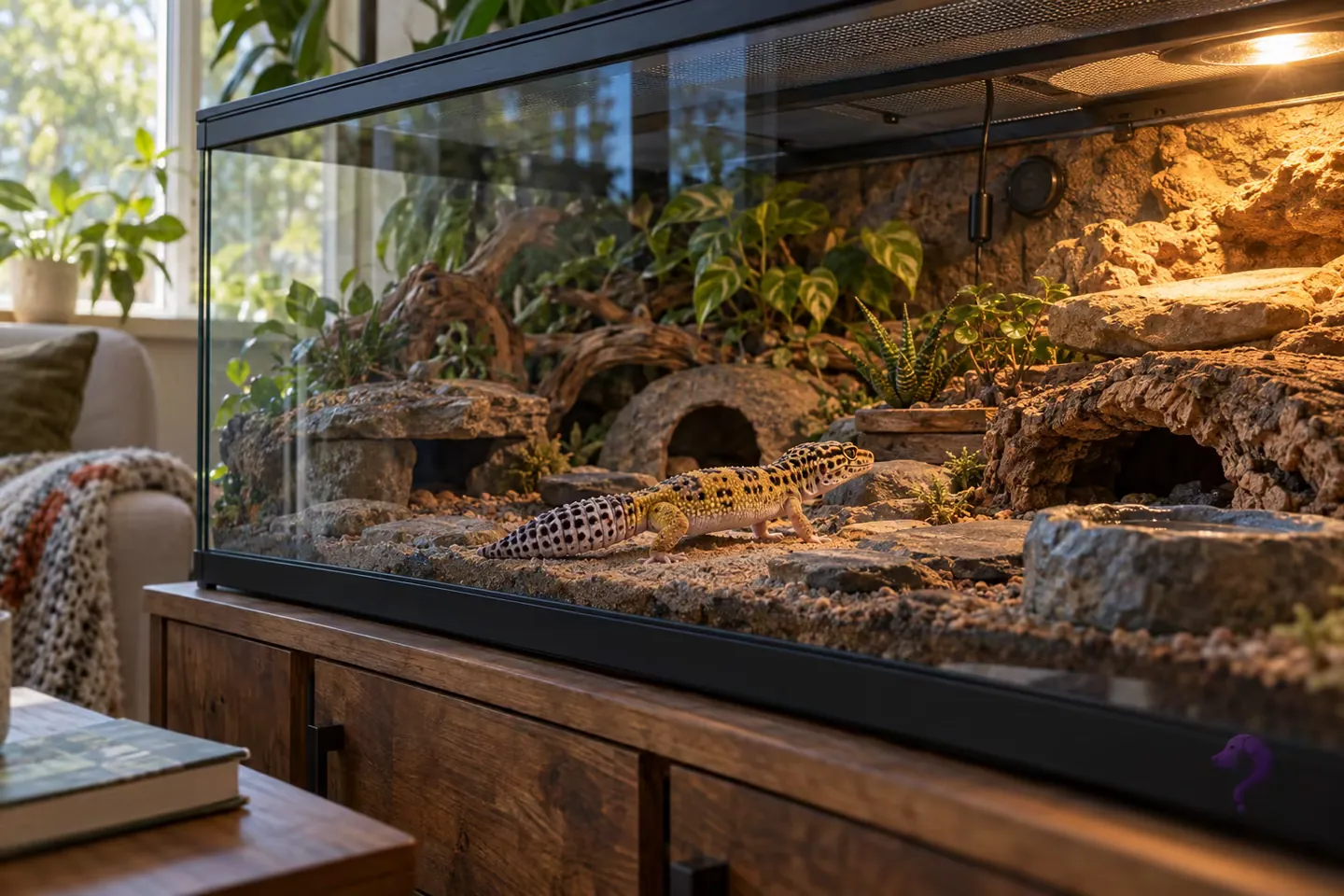
The short answer: start with the setup, not a list of easy reptiles
No reptile is an easy starter pet. Leopard geckos, crested geckos, bearded dragons, corn snakes, ball pythons, and blue tongue skinks are common first choices because their care is well documented. That does not mean their needs are interchangeable or forgiving.
For many prepared first-time keepers, a leopard gecko, crested gecko, or corn snake can be a sensible place to begin. A bearded dragon, ball python, or blue tongue skink may fit just as well when the larger enclosure, diet, humidity, or cost suits the home. The best first reptile is the one whose adult setup and food you can manage every day for many years.
Before choosing a species, decide whether you can keep measured heat, light, and humidity stable, store its food, pay for the equipment and electricity, and reach an exotics vet. If any part is uncertain, pause before buying the animal.
Six popular reptiles compared
This table is a shortlist, not a complete care plan. Once one or two species still look realistic, read current care guidance for that exact species and speak to an exotics vet before paying a deposit.
| Reptile | May suit you if | Think carefully about |
|---|---|---|
| Leopard Gecko | You want a small, ground-dwelling reptile and are happy to keep and feed live insects | Evening activity, insect care, supplements, heat, hides, and a long commitment |
| Crested Gecko | You have room for a tall planted enclosure and can maintain the right humidity without overheating it | Regular misting or another reliable water routine, climbing space, fragile skin and tail, and evening activity |
| Bearded Dragon | You want a visible daytime lizard and have room and budget for a large horizontal enclosure | Strong UVB and basking setup, fresh greens, live insects, cleaning, electricity, and more daily work |
| Corn Snake | You want a quiet snake and are comfortable storing and feeding frozen-thawed rodents | A long escape-proof enclosure, dawn and dusk activity, careful handling around feeding, and a long lifespan |
| Ball Python | You prefer a heavier-bodied snake and can monitor humidity closely | Frozen-thawed rodents, a secure adult enclosure, humidity management, possible feeding pauses, and a commitment that may last decades |
| Blue Tongue Skink | You want a sturdy daytime lizard and can provide a large floor-level enclosure and varied diet | Adult size, correct species identification, UVB and heat, food balance, weight control, and higher setup costs |
Build and test the enclosure before the reptile comes home
A reptile cannot move to the sofa when the enclosure is too hot, too cold, too damp, or too dry. Its home is the heating, lighting, humidity, shelter, exercise space, and much of its enrichment all at once.
Buy for the animal's adult size, not the small juvenile in the shop. Ground-dwelling species need useful floor area. Crested geckos need height and climbing structure. Corn snakes need enough length to stretch out and a lid or door that closes securely. Bearded dragons and blue tongue skinks need much more horizontal room than their pet-shop size may suggest.
Run the complete enclosure before the reptile arrives. RSPCA guidance recommends setting it up for at least a week and keeping temperatures stable for several days. Check the warm and cool areas with suitable thermometers, control heat sources with thermostats, confirm humidity with a hygrometer, and test timers, guards, hides, water, and lighting. The animal should not be the equipment test.
Food is often the quickest way to rule a species in or out
Could you keep live insects in the house? Leopard geckos need an insect-based diet. Bearded dragons and blue tongue skinks need more varied food, with the balance changing by species and age. Feeder insects also need suitable care and feeding before they become food themselves.
Corn snakes and ball pythons are commonly fed frozen rodents that have been fully thawed. If nobody in the home is comfortable buying, storing, thawing, and offering them safely, a snake is not the right compromise. Live vertebrate prey should not be the normal plan.
Crested geckos can eat an appropriate complete prepared diet, often with insects offered as part of a suitable plan. That can feel simpler than keeping insects as the main food, but the enclosure still needs correct temperature, humidity, water, cleaning, and observation. A convenient food does not make the whole animal low-maintenance.
Handling is optional for the reptile, even when you want it
Most reptiles are better described as animals to observe than pets that seek cuddles. Some individuals learn to tolerate calm, supported handling. That is useful for health checks, but it is not the same as affection and it should never be promised from a species label.
Leopard geckos need all four feet supported and must never be grabbed by the tail. Snakes need their full body supported. Bearded dragons and blue tongue skinks should be scooped from below rather than surprised from above. A reptile that backs away, opens its mouth, tightens its posture, or prepares to strike is asking for space.
Handling also removes a reptile from the controlled temperature of its enclosure. Keep sessions short, let a new animal settle before trying, and separate reptiles from cats, dogs, and other pets.
Leopard Gecko: compact does not mean equipment-free
A leopard gecko can suit someone who wants a quiet, ground-dwelling reptile with a smaller enclosure footprint than a bearded dragon or blue tongue skink. They are usually most active around dawn and dusk, so the best viewing time may be in the evening rather than during the working day.
The tradeoff is food and habitat detail. You need live insects, suitable supplements, a warm-to-cool gradient, several secure hides, a humid hide for shedding, clean water, and daily observation. They can live for many years, so this is not a short practice pet for a child who may lose interest.
Crested Gecko: think upwards and watch summer heat
Crested geckos use vertical space. Their enclosure needs safe climbing routes, cover, suitable humidity, water, and ventilation rather than the dry, low layout used for a leopard gecko. They are generally active in the evening and at night.
An appropriate prepared crested-gecko diet can reduce reliance on live insects, which may suit some homes. Humidity still needs to rise and fall in a healthy pattern, and warm rooms can become a problem because this is not a species that simply needs maximum heat. Plan for the hottest week in your home, not only an average winter day.
Bearded Dragon: more visible, but more daily work
Bearded dragons are active during the day, which appeals to people who want to watch normal behaviour while they are awake. They may become used to calm handling, but they still need choice and should usually live alone.
Their adult enclosure is large and technically demanding. A proper basking area, strong species-appropriate UVB, a cool area, safe substrate, hides, and enrichment all need to work together. Food commonly includes fresh plant matter and live insects, with needs changing as the animal grows. Add the cost of bulbs, electricity, food, replacement equipment, and an exotics vet before calling a bearded dragon beginner-friendly.
Corn Snake: quiet, active, and very good at finding gaps
Corn snakes are often suggested to first-time snake keepers because their care is well documented and many become accustomed to gentle handling. They are mainly active around dawn and dusk and can climb as well as move along the ground.
They need an escape-proof vivarium long enough for the adult snake to stretch out, with a heat and light gradient, humidity monitoring, hides at different temperatures, water, and climbing opportunities. Their food is normally frozen-thawed rodents. If the enclosure latch, feeding routine, or long adult length makes anyone at home uneasy, choose another species rather than hoping the discomfort disappears.
Ball Python: calm-looking does not mean simple
Ball pythons, also called royal pythons, are heavy-bodied snakes that often hide during the day. Some become calm during careful handling, but curling into a tight ball can be a fear response rather than a sign that the snake enjoys being held.
They need a secure enclosure large enough to stretch out, sturdy branches, snug hides, controlled heat, appropriate lighting, and closer humidity management than many new keepers expect. They eat frozen-thawed rodents and may sometimes refuse food. Anyone choosing one should know how to track weight and body condition and when to call an exotics vet rather than responding to every missed meal by changing the setup at random.
Blue Tongue Skink: a large floor plan and a varied menu
Blue tongue skinks are substantial ground-dwelling lizards, not oversized geckos. Adults can reach around 50 to 60 centimetres, and RSPCA guidance recommends a large horizontal vivarium for one animal. Different species and subspecies have different humidity needs, so correct identification matters before the enclosure is built.
They are omnivores with a varied diet and can gain too much weight in captivity. They also need a heat gradient, UVB, places to hide and burrow, and room to move. Their solid build and daytime activity may appeal to someone who wants a visible lizard, but the space, food planning, and setup cost are a poor fit for someone seeking the smallest option.
Reptiles and young children need an honest hygiene plan
Healthy-looking reptiles can carry Salmonella, and germs can spread from the animal, enclosure, equipment, food, and droppings. Wash hands with soap and water after contact and before eating. Keep reptile equipment away from kitchens and food-preparation areas, and do not let reptiles roam where food is prepared.
CDC guidance says children under five should not handle reptiles or their environments because they face a higher risk of serious illness. Older children still need close adult supervision for hygiene and animal welfare. An adult must own the care plan, the costs, and the daily checks. A reptile should not become a child's responsibility because it is quiet or lives behind glass.
Price the complete first year, not just the reptile
The animal may be one of the smaller costs. Add the adult enclosure, thermostat-controlled heating, UVB and other lighting where needed, lamp guards, thermometers, hygrometer, timers, substrate, hides, branches, food, supplements, cleaning supplies, electricity, replacement bulbs, transport, and veterinary care.
Find an exotics vet before choosing the reptile. Ask whether the practice routinely sees that exact species, what happens outside normal hours, and how far you would need to travel. Holiday care can also be harder than asking a friend to refill a bowl. The carer must understand the equipment, feeding, hygiene, and warning signs.
Use the pet-cost guide to test the budget and the renting guide to check permission, electricity, enclosure placement, and moving plans.
Buy or adopt the exact species you have researched
Choose a reputable rescue or seller that can give you the scientific species name, origin, age where known, feeding record, health history, and any legal or trade paperwork. Ask whether the animal was captive-bred. Never take a reptile from the wild, and do not buy an animal because the seller cannot care for it unless you already have suitable experience and professional support.
Rules vary by country and species. Some reptiles need permits, certificates, or proof of legal origin, and moving them across borders can introduce additional requirements. Check current local rules before paying, not after the animal is collected.
Be cautious around unusual colour morphs sold mainly for appearance. Ask whether the morph is linked to health or neurological problems and discuss concerns with an independent exotics vet.
Why turtles, tortoises, chameleons, iguanas, and large snakes are not in the table
What?Pet includes more reptiles than the six compared here. Turtles need a substantial aquatic system and water-quality plan. Tortoise care varies by exact species and may involve large indoor and outdoor areas, seasonal questions, and paperwork. Chameleons have specialised climbing, ventilation, hydration, and stress needs. Green iguanas and larger snakes bring adult size, strength, housing, and handling demands that do not belong in a short beginner shortlist.
Leaving them out is not a claim that nobody can care for them. It is an acknowledgement that a token table row would hide the most important work. If one of those animals is your first choice, begin with a full species-specific care plan and an exotics vet, not a generic reptile ranking.
Signs a reptile may fit your life
A reptile may suit you if you enjoy observing natural behaviour, can maintain equipment every day, and are comfortable with food and cleaning that other people may find difficult. Your home also needs space for the full adult enclosure in a stable location, plus a plan for power cuts, hot weather, travel, moving, and veterinary care.
The decision should still make sense if the reptile rarely tolerates handling. If touching the animal is central to what you want from a pet, another species may fit better.
When to wait
Wait if the animal is affordable but the adult enclosure is not, nobody will handle its food, or you cannot find a suitable vet. Wait if the enclosure would sit in direct sun, beside a radiator, in a draught, or somewhere the household cannot safely manage heat and electrical equipment.
Also wait if the decision depends on a reptile being cuddly, silent, odour-free, allergy-proof, cheap, or happy in a small tank. Use questions to ask before getting a pet to check the rest of the plan.
First-reptile checklist
This guide helps you compare common choices, but it is not a complete care sheet for any species. Husbandry guidance changes and needs vary by species, age, health, location, and individual animal. Use current species-specific welfare guidance and speak to an exotics vet before bringing a reptile home.
Common questions
What is the best reptile for a beginner?
There is no universal best reptile. A leopard gecko, crested gecko, or corn snake may be manageable for a prepared first-time keeper, but only if its enclosure, food, lifespan, and veterinary needs suit the home. Start by ruling out any food or setup you cannot maintain.
Is a leopard gecko or bearded dragon better for a beginner?
A leopard gecko usually needs less enclosure space, but it eats live insects and is most active around dawn and dusk. A bearded dragon is more visible during the day, but needs a larger enclosure, strong UVB, fresh plant food, live insects, and more daily work. Better means the care you can provide consistently.
Is a corn snake or ball python easier to care for?
Both need secure, heated enclosures and frozen-thawed rodents. Corn snakes are generally more active and need useful length and climbing opportunities, while ball pythons are heavier-bodied and usually need closer humidity management. Compare the complete adult setup rather than choosing by appearance.
Which beginner reptile does not need live insects?
Corn snakes and ball pythons are normally fed frozen-thawed rodents rather than insects. Crested geckos can use an appropriate complete prepared diet, often with insects included in a suitable feeding plan. If you are uncomfortable with every realistic food option, wait before getting a reptile.
Are reptiles low-maintenance pets?
No. They may not need walks or coat grooming, but their enclosure is life-support equipment. Heat, lighting, humidity, water, food, cleaning, observation, replacement equipment, and specialist veterinary care all require planning.
Are reptiles good pets for children?
They can suit some homes with older children who enjoy observing animals, but an adult must manage the care and hygiene. CDC guidance says children under five should not handle reptiles or their environments because of the risk of serious Salmonella illness.
Sources and further reading
Welfare and care statements on this page are informed by publicly available guidance from recognised animal-welfare organisations. Always check current advice for your location.
- Caring for reptiles and other exotic pets - RSPCA
- How to care for a leopard gecko - RSPCA
- Caring for your crested gecko - RSPCA
- How to care for your bearded dragon - RSPCA
- How to care for a corn snake - RSPCA
- How to care for a royal python - RSPCA
- Blue-tongued skink - RSPCA
- Taking your reptile home - RSPCA
- Special considerations for reptiles - Merck Veterinary Manual
- Salmonella outbreaks linked to geckos - US Centers for Disease Control and Prevention
Want a more personal answer?
What?Pet™ helps compare pets around your home, routine, budget, allergies, noise, and care needs.
Get the app